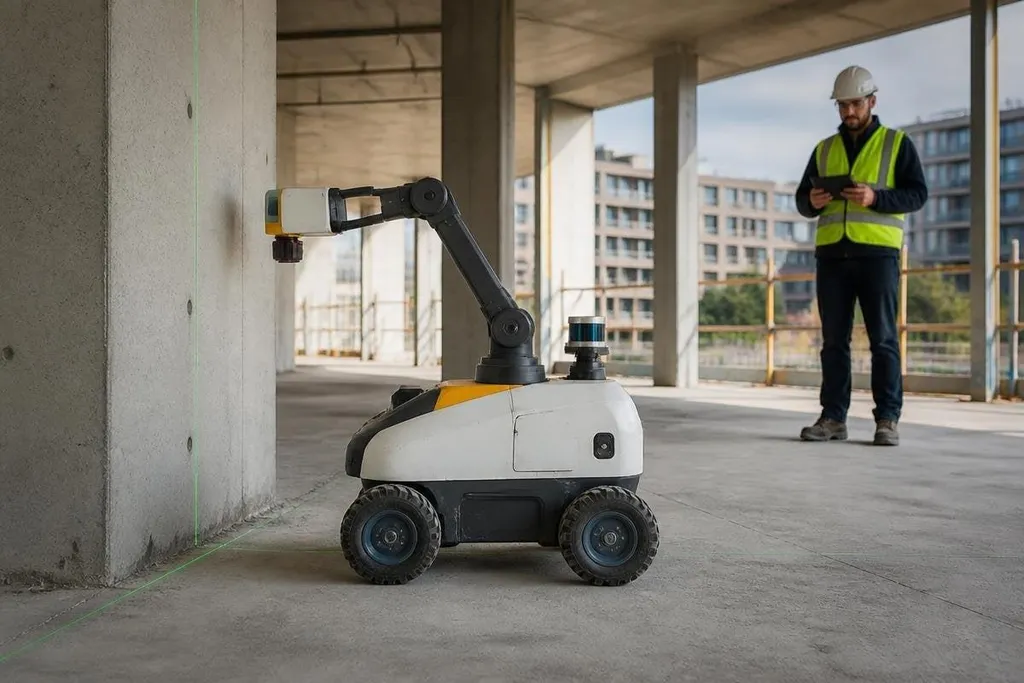
A construction robot does one job well before it takes on a whole building site. That job might be marking wall lines, placing bricks, scanning a structure, or moving material through a fixed route.
For a site manager, the useful question is practical: which task can a robot repeat safely, with less setup and less downtime?
- Robots work best on repeated tasks with a clear work area.
- LiDAR, cameras, and GNSS help machines map position and avoid obstacles.
- People still handle site changes, checks, repairs, and many final decisions.
Where robots fit on a building site
Construction sites change day by day. A robot that works well on a flat slab may need new software, a new route, or a different tool when the floor, walls, or access points change.
That makes task choice more important than the robot’s shape. A tracked mobile robot can carry materials across a prepared route. A robotic arm can place objects within a set reach. A small inspection robot can enter spaces that are unsafe or difficult for a person to check.
Layout robots are one clear example. They use cameras, LiDAR, or total-station data to mark positions on a floor. The benefit is tied to the task: a crew can check reference points before drilling, framing, or installing services.
The robot still needs a clean digital plan and a site that matches that plan. Poor drawings, moved barriers, or blocked paths can turn an automated run into a manual correction job.
Repeated work is the first target
Bricklaying, concrete printing, drilling, painting, and material movement all contain repeated steps. That makes them easier to describe in software than work that changes with every wall or room.
A bricklaying system needs a steady supply of blocks, mortar, and power. Its arm must place each block within a set position.
A person still needs to check the work against the design. A concrete printer adds another limit: the mix must leave the nozzle at a steady rate and hold its shape after placement.
Demolition robots use a different setup. A remote operator controls a tracked base and a hydraulic arm from outside the immediate work area. The machine takes on the reach and force of the task, but the operator remains responsible for the view, route, and stop decision.
That split matters. Automation can reduce a person’s exposure to dust, falling material, or unstable structures, but it doesn't remove the need for a trained crew around the machine.
The site still sets the limits
Indoor construction often gives robots better conditions than open ground. Floors are easier to map, routes are shorter, and power may be close. Outdoor sites add mud, uneven ground, weather, changing access, and other machines sharing the same space.
Before work starts, the team may need to set markers, check the map, charge batteries, fit a tool, fence off the work zone, and confirm the emergency stop. Those steps count in the schedule even when the robot’s working motion looks quick.
Construction sites change after the plan is set. Weather or another trade can force a new route or tool. Construction robot reporting from Robot24.com can connect those changes with named machines and site tests, so you can judge whether the robot still cuts total labor after a person resets it.
The open question is not whether a robot can repeat a movement. It is whether the full work package, including setup, supervision, repair, and site changes, beats the current method.
A practical buying check
Before a contractor accepts a construction robot for a live project, the team should check:
- Name the task: Write down the exact repeated action, its start point, end point, and acceptable result.
- Map the work area: Mark slopes, doors, barriers, people, power points, and places where the robot must stop.
- Check the inputs: Confirm that drawings, materials, tools, and measurements arrive in the format the system needs.
- Count human work: Include loading, supervision, cleaning, tool changes, inspection, and recovery after a fault.
- Plan the stop: Set the emergency stop location, operator role, exclusion zone, and restart procedure before the first run.
- Measure the result: Compare finished work, setup time, rework, and crew hours with the existing method.
I’d start with a task that is repetitive, easy to measure, and costly for people to repeat. A system that needs a new plan every hour is a poor fit, even if its arm moves well in a demonstration.
The next useful step is a small site trial with one defined task. Keep one measure for setup and finished work, then decide whether the robot earned a wider role.